What a one-percent pack chance actually means
Understand repeated probability, expected hits and why a cold streak does not make a pack due.
One opening and twenty openings are different questions
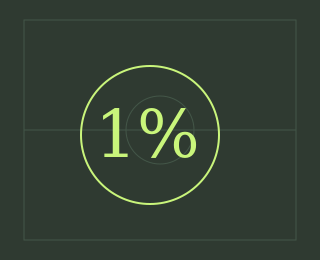
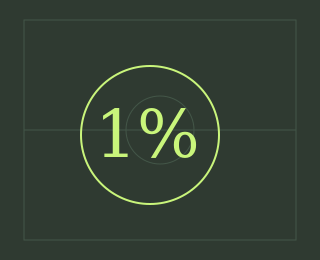
Suppose a precisely defined target has a one-percent probability in one pack. This is an illustrative input, not a statement of any current EA pack odds. The chance of missing that target in one opening is 99 percent. Under an independent, constant-probability model, the chance of missing it in twenty openings is 0.99 multiplied by itself twenty times.
The chance of at least one hit is therefore one minus that value: about 18.2 percent. Twenty one-percent chances do not create a guaranteed hit, and the probability of at least one hit is not exactly twenty percent.
Expected hits are not promised hits
The expected number of hits in twenty openings is 20 × 0.01 = 0.2. That number is a long-run average across many repeated sets of twenty openings. You cannot receive one fifth of a target in an individual set. A particular set may contain zero, one, or more.
Keep the expected count separate from the probability of at least one. They answer different questions. Touchline displays both to make the distinction visible.
A previous miss does not make a hit due
In the independent model, the next pack still has the original probability after a losing streak. Do not use a cold run as a reason to spend more. Likewise, an unusually good result does not prove the same outcome is likely again.
The model assumes that probabilities do not change between openings. In practice, compare only the exact pack and target definition you are considering. Different promotions, pack types and disclosed categories may use different probabilities. Do not transfer one percentage to another category.
Track actual coin flow
Your ledger should distinguish the cost of a pack from the coins you actually recover. An untradeable card may be useful in your squad, but it is not a sale receipt. Assigning a speculative market value to it can make the return appear more liquid than it is.
Enter zero coin cost for a free reward pack. Keep FC Points spending separate: the Touchline coin ledger does not convert real-money purchases into coins. Its net figure is recorded coin proceeds minus recorded coin costs, not financial profit.
Use the numbers to slow a decision down
Enter a hypothetical probability in the explorer and vary the pack count. Pay attention to the chance of no hits, even when the number of openings is large. This makes uncertainty visible rather than hiding it behind an attractive expected value.
A personal pack log is a convenience sample. It is not large or representative enough to establish official probabilities. Keep it as a record of your own experience and a way to evaluate a spending decision calmly.
| Openings | Chance of at least one hit | Chance of no hits |
|---|---|---|
| 1 | 1.0% | 99.0% |
| 10 | 9.6% | 90.4% |
| 20 | 18.2% | 81.8% |
| 50 | 39.5% | 60.5% |
| 100 | 63.4% | 36.6% |
Values are rounded from 1 − (1 − p)n, with p = 0.01. They are an explanation of a model, not current pack disclosures. Even one hundred openings leaves a substantial chance of no target under these assumptions. A cumulative probability is not a guarantee or a spending target.
Check exactly what a probability describes
A probability for a broad item category is not necessarily the probability of one named card. Read the current in-game disclosure and its scope before using a number. If the displayed figure is only a lower bound, or if the pack contents and target definition are unclear, a precise personal-player calculation is not justified. Leave the uncertainty visible.
For a hypothetical set costing 10,000 coins and returning 3,000 recorded coins, the ledger net is −7,000 coins. It does not become a coin gain because you assign an untradeable card a high imaginary selling price. Utility to your squad and recoverable coins belong in different notes.
Set your own limit before opening rewards or spending. Stop at that limit rather than increasing it after a disappointing run. Free rewards can be logged without turning the exercise into a reason to buy more. If you are deciding between a known squad change and an uncertain pack outcome, the budget upgrade worksheet helps you describe the actual problem you want to solve.
One idea. Your next match.
Turn the story into a small experiment with Match Lab. Make one change, keep a note, and see what your matches tell you.
Open Match Lab ↗Original Touchline guide. These are review methods and coaching hypotheses, not official EA advice or guaranteed game mechanics. Editorially reviewed 16 October 2026. Editorial standards · Report a correction. Illustrations are conceptual, not match measurements.