Before you change your striker, review the chance.
A five-clip routine to separate a rushed decision from a difficult shooting opportunity.

The final shot is only the last decision
A missed chance can feel like a card problem. Sometimes it is a difficult chance, sometimes it is a rushed input, and sometimes the attack offered a better next action. Before replacing a player, collect five missed attempts from a normal session. Include ordinary misses rather than only the most frustrating ones.
This is a review routine, not a claim about a specific shot mechanic or a guaranteed way to finish. Controls and tuning vary between game versions. The purpose is to make your next practice task more precise.
Ask three questions at the freeze frame
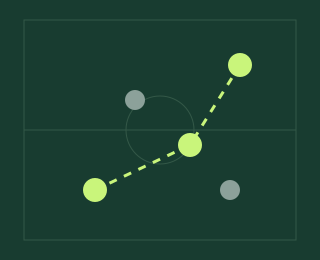
Pause just before the shot. First, was the shooting lane clear, or was a defender between the ball and goal? Second, was the player balanced after the previous touch, or still turning away from the target? Third, was another player available in a visibly better position?
Write one short observation for each attempt. “I was rushed” is less useful than “I shot while turning across a defender.” Keep uncertainty in the note when the camera does not show enough. A goalkeeper save alone does not identify the cause of a miss.
Group the misses before choosing a drill
If most examples are blocked lanes, work on recognising the defender before the shot. If they are awkward first touches, practise taking a simpler touch into space. If a nearby teammate repeatedly has a clear opportunity, test looking for that option before forcing an attempt.
Do not turn the last idea into a rule that you must always pass. An extra pass can close a good shooting window. The aim is to recognise the choice, rather than to repeat a fixed sequence regardless of the situation.
Make the next session a small test
Choose the most common condition in your five clips and write one intention for the next matches. For example: “Check the lane before committing to the shot.” Keep the rest of your squad and tactics stable so the test has a clear focus.
Record what happened in the match journal. Goals per match can provide context, but opponent strength, match state and the number of opportunities all affect that figure. Review several new clips to see whether the original habit changed, even if the scoreline did not immediately improve.
Decide what to keep
After the session, compare the decisions in your new clips with the original five. If the same rushed situation remains, simplify the practice task. If the decisions look better but results are mixed, gather more examples before concluding that the approach failed.
A useful review ends with one specific next action. It does not require you to label every miss as bad luck or rebuild the entire attack after one evening.
| Before the shot | What the clip shows | Next practice cue |
|---|---|---|
| Turning receiver | Shot taken across a nearby defender | Look at the lane before the final input |
| Clear passing option | Teammate visible beyond the last defender | Notice the option; choose rather than force it |
| Unclear camera | Balance and goalkeeper position not visible | Keep as uncertain, not proof of a card problem |
Include the chances that went in
Reviewing only misses can distort your conclusion. Add two scored attempts from similar positions and ask the same questions. A goal from a crowded lane does not make that lane consistently good, and a saved attempt from a clear position does not make the decision poor. Compare the choice before you know the outcome whenever you can.
A practical routine is to pause before the shot, write your preferred next action, then play the clip. This separates the decision from the emotion attached to the result. Keep the note descriptive: “defender between ball and goal” is evidence you can inspect; “the game wanted a miss” is not a testable observation.
Use a simple denominator
If your practice cue concerns blocked lanes, record blocked attempts out of all attempts you reviewed. A fall from four blocked shots in eight reviewed attempts to two in four is the same proportion, despite the smaller count. Different opponents and chances still limit the comparison. Treat a small session as feedback about a habit, not as a reliable estimate of a player's finishing ability.
Only after the recurring decision problem becomes clearer should you consider whether the player profile fits your chosen role. See giving every player a job for that separate question.
One idea. Your next match.
Turn the story into a small experiment with Match Lab. Make one change, keep a note, and see what your matches tell you.
Open Match Lab ↗Original Touchline guide. These are review methods and coaching hypotheses, not official EA advice or guaranteed game mechanics. Editorially reviewed 16 October 2026. Editorial standards · Report a correction. Illustrations are conceptual, not match measurements.