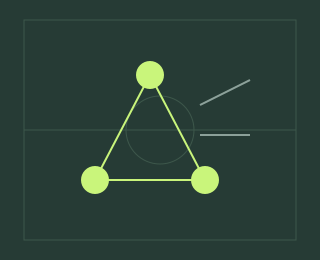
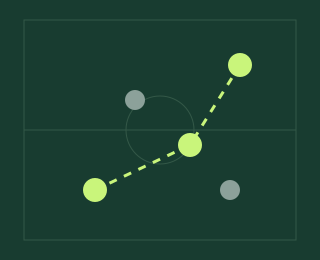
Test a tactic without changing everything at once.
Build a simple baseline, change one variable, and use comparable clips and match notes to decide what to keep.
Write a claim you can actually inspect
“This tactic wins more” is a broad claim with many possible causes. Start smaller: “Adding a nearby support option will reduce the number of times my forward receives with no usable next pass.” That tells you which moments to review and what would count against your idea.
Touchline's diagrams are planning aids. They do not simulate EA's player movement, and their numerical sliders are not game tactics codes. Copy the actual setting names from your edition into your notes. If a patch changes those settings or their behaviour, begin a new comparison rather than mixing old and new matches silently.
Save a baseline you can reproduce
Record the edition, game mode, formation, relevant roles or instructions, squad and the behaviour you want to change. Give the setup a descriptive name. “Midfield support baseline” will be more useful later than a name that claims it is unbeatable.
Use a few normal matches to collect examples before changing the setup. Do not choose only your worst defeat as the baseline. That creates an unfair comparison with an ordinary next session. Keep successful examples as well as failures so you can see when the current approach already works.
| Field | Illustrative entry |
|---|---|
| Problem | Forward receives without a nearby next pass |
| Hypothesis | One support role creates a usable connection |
| Change | One relevant role setting in the current game |
| Keep stable | Mode, squad and other tactics where practical |
| Observe | Isolated receptions / all reviewed forward receptions |
| Watch the cost | Fewer runners beyond the ball |
| Revert if | Connection stays absent and the attack loses depth |
Choose a fair unit of observation
If you are testing isolated receptions, count isolated receptions out of the total forward receptions you reviewed. Match wins are useful context but too distant from the question to explain the result by themselves. If you are testing transition cover, define the dangerous transition before counting it. Avoid changing the definition after a good or bad result.
A small example makes the limitation clear. Suppose the baseline has eight isolated receptions from twenty reviewed receptions and the test has four from twelve. The rates are 40 percent and about 33 percent. That is a descriptive difference in a small set, not proof that the change caused an improvement. The opponents and situations may differ.
Change one thing, then inspect the intended behaviour
Before collecting another long session, check an early replay. Did the intended support player appear where you expected? If the setting did not create the relationship, there is little value in interpreting a later winning streak as support for the original explanation. Investigate the actual movement first.
Do not change the formation, several player roles and three cards together unless you are deliberately testing the entire package. A package comparison can still be useful, but it cannot identify which ingredient caused the difference. Label it honestly in the journal.
Keep context beside the numbers
Record unusual factors: a red card, a large score deficit, a change of mode, or a session where you were distracted. Keep those matches visible and marked rather than removing inconvenient results after seeing them. If you choose an exclusion rule, decide it before reviewing the outcome and say why it fits the question.
The match journal stores your manual entries locally. The experiment notebook can hold your baseline and test labels. Neither tool knows opponent strength or verifies the clips for you. The quality of the comparison depends on the observations you supply.
Decide whether to keep, revise or revert
Keep a change provisionally when the intended behaviour appears more often and its costs remain acceptable. Revise the hypothesis when the footage shows a different cause. Revert when the relationship you wanted does not appear or the tradeoff hurts the way you want to play. These are three useful outcomes, not one success and two failures.
If the question remains unclear, gather a few more comparable examples before making another change. Avoid turning a small test into a statistical claim about every opponent or every player.
Build a personal playbook
End with one sentence: “I use this setup when I need this kind of support, and I watch for this cost.” Link that note to a representative clip and a named setup. Over time, those explanations make your choices easier to adapt than a collection of unexplained tactic codes.
For starting shapes, use the formation tradeoff guide. For central defensive behaviour, use the midfield positioning review. Choose the next test from a specific problem you can show, then let the next set of evidence refine the idea.
One idea. Your next match.
Turn the story into a small experiment with Match Lab. Make one change, keep a note, and see what your matches tell you.
Open Match Lab ↗Original Touchline guide. These are review methods and coaching hypotheses, not official EA advice or guaranteed game mechanics. Editorially reviewed 16 October 2026. Editorial standards · Report a correction. Illustrations are conceptual, not match measurements.